

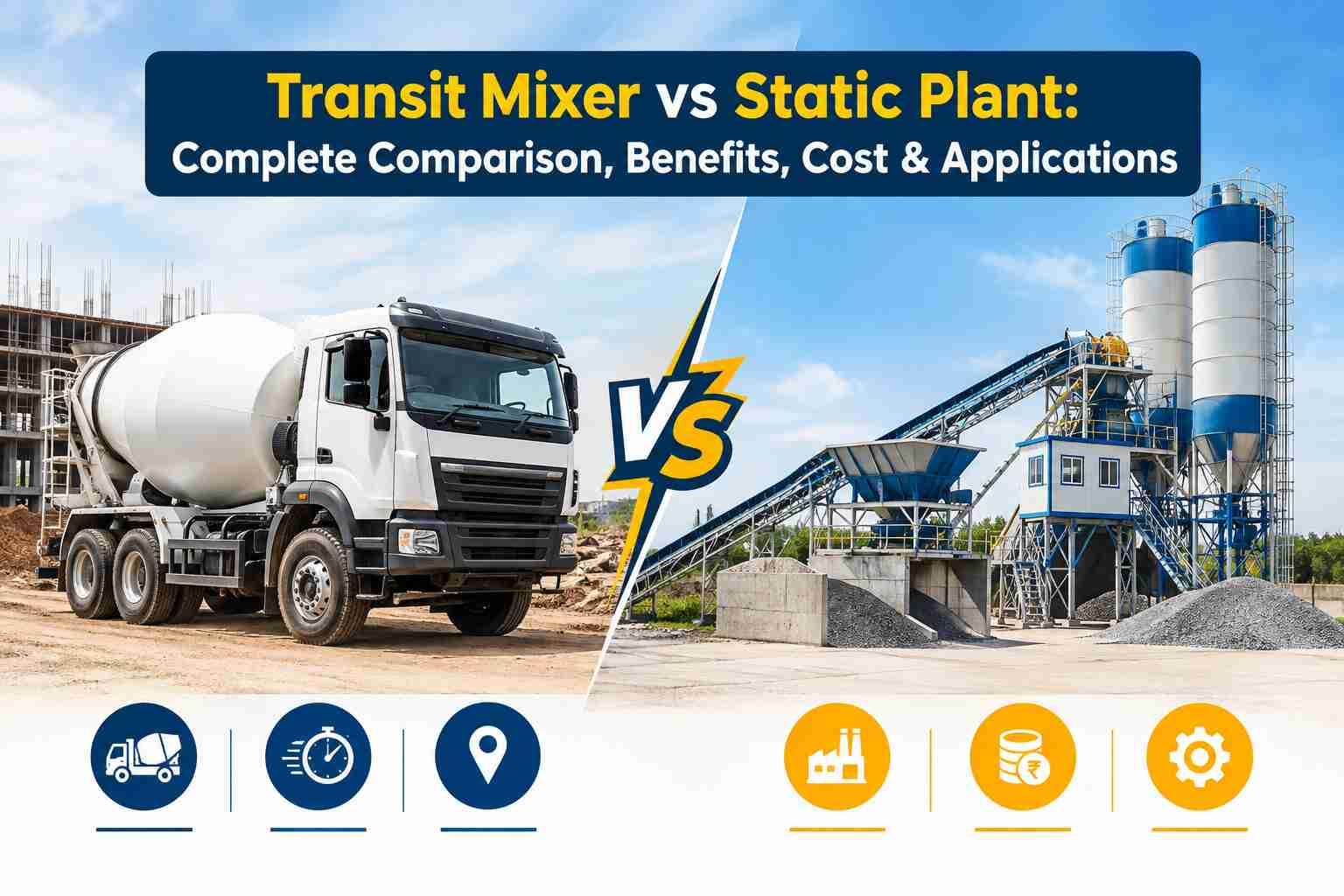
Choosing the right concrete production and delivery system is one of the most important decisions for construction companies. The wrong choice can increase project costs, create delays, and affect concrete quality. Two commonly used solutions in the ready-mix concrete industry are Transit Mixer vs Static Plant. At Spectrum Concrete Pvt. Ltd., we help businesses choose reliable concrete solutions based on their project requirements, ensuring quality, efficiency, and timely delivery for different construction needs.
Both systems have their unique strengths, and this is based on the project sizes, locations, production needs, and budgets. However, while a transit mixer system centers on transporting concrete, the static mixing plant concentrates on the production of large volumes of concrete.
For businesses looking for reliable concrete solutions, Ready Mix Concrete Plants in Delhi provide an efficient option for large-scale projects where consistent quality and continuous supply are important. Understanding the difference between these two systems helps contractors choose the right equipment for their construction needs.
What Is a Transit Mixer?
The transit mixer truck is a type of truck specially built for the mixing and transportation of concrete from where it is produced to the site of work. The rotating drums on these trucks keep the concrete moving while being transported to maintain its composition.
Transit mixers are widely used for:
- Residential construction projects
- Commercial buildings
- Road construction
- Infrastructure projects
- Small and medium concrete requirements
The most important benefit of a transit mixer is the mobility that comes along with it. Since the concrete is delivered to the site directly, one can handle the project where the construction site keeps changing.
If the companies require a temporary supply of concrete without buying any machinery, then Transit Mixer on Rent in Delhi is an appropriate solution. This will help save money initially.
What Is a Static Plant?
A static plant, also known as a stationary concrete batching plant, is a fixed concrete production facility designed for large-scale concrete manufacturing.
Unlike a transit mixer that mainly focuses on transportation, a static plant handles the complete concrete production process, including:
- Material storage
- Aggregate measurement
- Cement mixing
- Water and additive control
- Concrete quality management
Static plants are commonly used for:
- High-rise buildings
- Bridges
- Highways
- Large infrastructure projects
- Continuous construction operations
A stationary plant offers better production capacity and consistent output because all operations happen at one controlled location.
Transit Mixer vs Static Plant: Key Differences
Understanding the difference between these two systems makes the selection process easier.
| Factor | Transit Mixer | Static Plant |
| Main Purpose | Transportation and delivery of concrete | Large-scale concrete production |
| Mobility | Highly mobile | Fixed location |
| Production Capacity | Limited by truck availability | High production capacity |
| Best For | Small and medium projects | Large construction projects |
| Setup Requirement | Minimal setup | Requires installation area |
| Investment | Lower initial cost | Higher investment |
| Flexibility | Very flexible | Less flexible due to fixed location |
Production Capacity Comparison
Production capacity is one of the biggest factors when comparing a transit mixer and static plant.
A transit mixer depends on the number of available trucks and their delivery schedule. For projects with smaller concrete requirements, this approach works efficiently.
But in cases of huge constructions, there is a need for constant supply of concrete. A static plant is the best option in such cases, as it can produce huge amounts of concrete from a central location. We at Spectrum Concrete Pvt. Ltd. know the significance of having a constant supply of concrete and can offer solutions for the same.
Companies searching for dependable Ready Mix Concrete Plants in Delhi often choose static plants because they support long-term projects requiring consistent concrete production.
Quality and Concrete Consistency
Concrete quality depends on accurate measurement, proper mixing, and controlled processes.
Static plants usually provide better quality control because materials are measured and mixed under controlled conditions. This helps maintain uniform concrete strength throughout large projects.
Transit mixers also deliver quality concrete, especially when maintained properly and supplied through a reliable concrete producer. The rotating drum helps prevent concrete from settling during transportation.
The choice depends on project requirements. A small project may not require a large stationary plant, while a highway or commercial project may need centralized production.
Cost Comparison: Transit Mixer vs Static Plant
Cost is another major factor that influences the decision.
Transit Mixer Cost Benefits
Transit mixers generally require lower investment because they do not need a permanent production setup.
Advantages include:
- Lower equipment cost
- No plant installation expense
- Easy transportation
- Suitable for temporary projects
For contractors who require concrete delivery occasionally, Transit Mixer on Rent in Delhi can reduce operational costs significantly.
Static Plant Cost Benefits
Static plants require higher investment because they involve:
- Land requirement
- Installation cost
- Storage systems
- Maintenance expenses
However, for large projects, the higher initial investment can provide better returns because of higher production capacity and reduced dependency on external suppliers.
Applications of Transit Mixer
Transit mixers are suitable for projects where mobility and quick delivery are important.
Common applications include:
Residential Construction
Housing projects often require flexible concrete delivery schedules. Transit mixers help deliver concrete directly to different locations.
Small Commercial Projects
Shopping complexes, offices, and small infrastructure projects can benefit from flexible concrete transportation.
Remote Construction Sites
When construction locations are far from concrete plants, transit mixers help maintain supply efficiency.
Applications of Static Plant
Static plants are preferred for projects requiring continuous concrete production.
Common applications include:
Highways and Bridges
Large infrastructure projects require thousands of cubic meters of concrete with consistent quality.
Large Residential Projects
Townships and apartment developments need regular concrete supply for multiple construction stages.
Industrial Projects
Factories and industrial facilities often require high-volume concrete production.
Which One Should You Choose: Transit Mixer or Static Plant?
The right choice depends on your project requirements.
Choose a Transit Mixer if:
- You need flexible concrete delivery
- Your project size is small or medium
- You do not want installation costs
- Your construction locations frequently change
Choose a Static Plant if:
- You need high production capacity
- Your project runs for several months or years
- Quality consistency is a priority
- You require continuous concrete supply
Many construction companies combine both solutions by using static plants for production and transit mixers for transportation.
How to Find the Right Concrete Solution in Delhi?
Before selecting a concrete solution, consider:
- Project size
- Required concrete volume
- Delivery distance
- Construction timeline
- Budget limitations
- Quality requirements
Comparing the available suppliers and services is possible using various web-based sites and business directories. For instance, the firms interested in getting Ready Mix Concrete Plants in Delhi are able to compare different local providers depending on their experience, equipment availability, and customer ratings.
Final Thoughts
Comparison between Transit Mixer and Static Plant depends totally on your construction needs. The transit mixers are flexible, mobile, and easy to deliver. Meanwhile, static plants are productive, efficient, and reliable.
If you are planning to carry out a small construction project, transit mixers may be an economic option. However, if you plan to build a big construction project, then static plants will be more productive.
Determining your construction needs before purchasing equipment may help you save both time and money.