

Concrete is the support of modern construction. Big houses and big bridges are constructed by the builders using the appropriate grade of concrete in order to make sure that it is strong, safe, and stable. When you intend to do a project in a busy city such as Delhi, then you can save time, waste, and enhance quality on the first day when you have to work with trustworthy ready mix concrete dealers in Delhi.
This guide shall provide an explanation of what grade of concrete is, how various grades of concrete perform their work, and where each grade fits within a real construction project. We shall not be speculative, or guessing, or wordy, we shall be plain, and true, and simple.
What Is Grade of Concrete?
The concrete grade determines the concrete strength following a 28 days curing period. This strength is measured in megapascals (MPa) by the engineers. M20 in example indicates that the concrete is capable of compressive strength of 20MPa.
Simply put, the grade will indicate the strength of the concrete. The correct grade of concrete depends on the type of load, the environment, and the type of structure chosen by the builders.
The Bureau of Indian Standards (BIS) in India provides concrete grades under the IS 456: 2000, which provides a guide to any engineer and contractor involved in residential, commercial, and infrastructure construction.
You May Also Like : Smart Ways to Rent a Concrete Mixer Without Breaking the Budget
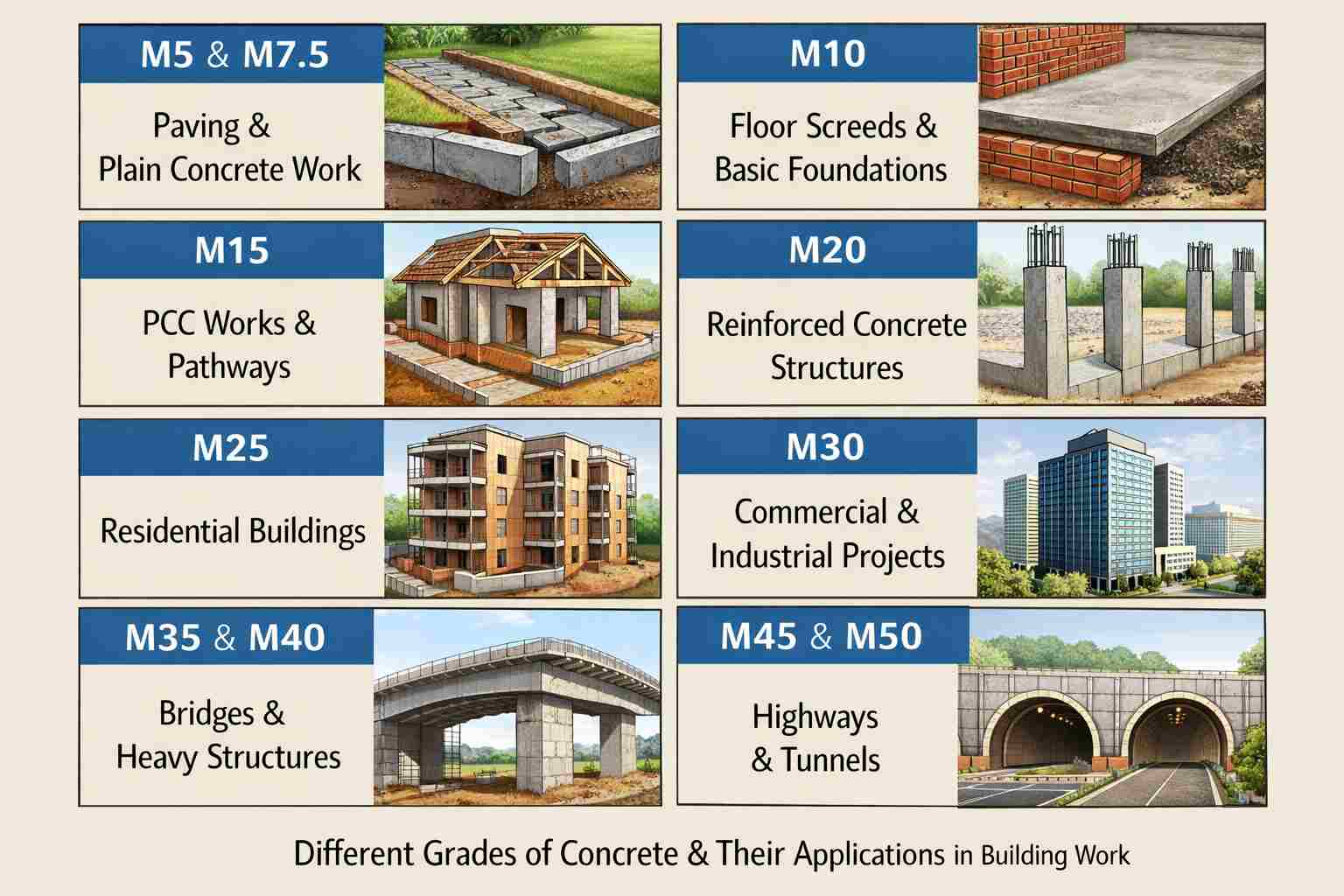
Concrete Grades List Used in Building Work
Knowing the list of common concrete grades makes you make the appropriate choice of material. The most popular grades in construction are listed below.
M5 to M7.5 – Lean Concrete
These are low-strength grades. They are typically used by workers as leveling and temporary work.
Typical Uses:
Road base preparation
Footpath bedding
Non-structural filling
The basic concrete mix ratio applied in these grades is like:
1 : 5 : 10
(Cement : Sand : Aggregate)
These grades are not common structural components among the builders as they lack the required strength.
M10 to M20 – Standard Residential Construction
These grades of concrete are relied upon in most residential buildings. They provide a reasonable balance between price and strength.
Common Applications:
- House foundations
- Floor slabs
- Light load Beams and columns.
- Pavements and driveways
Typical Mix Ratios:
- M10 – 1 : 3 : 6
- M15 – 1 : 2 : 4
- M20 – 1 : 1.5 : 3
Of these, M20 is still one of the most popular grades in India. As per the BIS standards, the minimum suggested grade of concrete in reinforced cement concrete (RCC) is M20.
M25 to M40 – High-Strength Structural Concrete
These grades sustain heavy loads and structural designs that are difficult. They are commonly defined by engineers to multi-story and commercial buildings.
Typical Uses:
- High-rise buildings have columns and beams.
- Industrial floors
- Bridges and flyovers
- Parking structures
The mixes, as opposed to lower grades, are typically not based on ratios but rather on design calculations. Controlled batching enhances consistency and strength and many contractors today obtain them in ready mix concrete plants in Delhi as they improve the grades.
M45 and Above – Ultra-High Strength Concrete
These grades are used in engineering projects of a specialized nature. They provide high strength and life under extreme conditions.
Common Applications:
- Dams
- Metro rail infrastructure
- High-load industrial structures
- Marine construction
The grades require the high-level control of materials, testing, and professional control. Ready-mix technology contributes greatly towards the manufacture of such high-performance concrete in a safe manner.
Concrete Mix Ratio Explained
Concrete mix ratio is the proportion of cement, sand, and aggregate to form a particular grade of concrete.
An appropriate ratio guarantees:
- Adequate strength
- Long-term durability
- Reduced cracking
- Better load performance
Here is a quick reference table:
| Grade | Mix Ratio | Typical Use |
| M10 | 1 : 3 : 6 | Leveling and non-structural work |
| M15 | 1 : 2 : 4 | Residential flooring |
| M20 | 1 : 1.5 : 3 | RCC structures |
| M25 | Design Mix | Structural elements |
The construction sites today are becoming more and more reliant on automated batching systems that are found in the ready mix concrete plants in Delhi. These facilities have a high level of quality control and this minimizes human error and enhances reliability.
Applications of Different Grades of Concrete in Building Work
Concrete is available in different grades that have their purpose. When the grade is incorrect, it may result in cracks, structural failure or even expensive repairs. The selection of the appropriate one makes the building safe and adhering to the engineering standards.
Residential Buildings
Most houses use:
- M20 on slabs and beams.
- M25 for columns
- Flooring should be M10 or M15.
The builders like these grades as they offer good strength without the needless expenditure.
Commercial Buildings
The concrete grades that are required in commercial structures are larger because of the increased loads and the continuous use.
Typical grades include:
- M25
- M30
- M35
These grades enhance strength and durability and help to carry heavier equipment, elevators, and overweight occupancies.
Infrastructure Projects
High-performance materials are needed in infrastructure projects. Engineers often specify:
- M40 and above
- Specialized design mixes
These grades are not affected by weather, vibration, and heavy traffic in the long run.
How to Choose the Right Grade of Concrete
The choice of the concrete grade is not only regarding its strength. There are a number of practical factors to be consider.
1. Load Requirements
Heavy loads require better grades. Even a basic driveway does not require the strength of a multi-story building.
2. Environmental Conditions
Regions that are expose to wet or chemical conditions or in extreme weather conditions demand a higher grade of concrete.
3. Construction Speed
The large projects tend to depend on the ready-mix supply to sustain the continuous flow. Good reliable ready mix concrete plants in Delhi are able to assist contractors to meet deadlines without affecting quality.
4. Budget Planning
University education is more expensive. Planning smartly is a balance between safety and affordability.
Role of Ready Mix Concrete in Modern Construction
Ready-mix concrete has revolutionized the efficiency in construction in India. Rather than mixing materials on site, the contractors now request ready-to-mix concrete which is shipped to a project site.
This solution has a number of benefits:
- Consistent quality
- Faster construction
- Reduced labor costs
- Less material waste
Numerous constructors are ready to collaborate with reputed ready mix concrete suppliers in Delhi since they offer certified products and deliver on time.
In case you need a reliable supplier, you can find the address of Spectrum Concrete Pvt. Ltd on their Google My Business profile rather easily. This ensures that it is easy to check their services, reviews left by customers and logistics about the site before making an order.
The suppliers are also professional with numerous ready mix concrete plants in Delhi and this ensures continuous availability even during the high seasons of construction. This reliability is valued by contractors since delays are known to raise the cost of the project in a short time.
For large-scale projects, experienced ready mix concrete dealers in Delhi often provide technical guidance on selecting the correct grade of concrete, slump level, and delivery schedule.
Final Thoughts
Choosing the correct grade of concrete is one of the most important decisions in any construction project. The right grade ensures safety, durability, and long-term performance. The wrong choice can lead to structural problems, repair expenses, and safety risks.
Modern builders rely on standardized concrete grades, proper concrete mix ratio, and professional supply systems to deliver consistent results. With the growth of automated batching and certified suppliers, construction quality continues to improve across residential and commercial sectors.
Reach out today to discuss your project, request technical support, or schedule concrete delivery. The right materials and the right support team can make your construction process faster, safer, and more cost-effective.